What is the role of Phonics in teaching language?
If you are a little confused or intimidated by the concept of Phonics then you are likely not alone, especially if you did not experience this concept during your own early learning.

Phonics is now an established mainstream practice for teaching children the English alphabet and related pronunciation and also reading and spelling of words. The phonics method achieves this via leveraging the relationship between sounds (“Phonemes”), letter groupings related to those sounds (“Graphemes”) and the spelling and sounding of a whole word incorporating several letter groupings.
There is a wealth of academic literature on this subject but, while the concept is widely accepted these days, debate continues over the practical application for teaching vs other methods such as the “Whole Language” method. So something that at face value should be relatively straightforward – I mean we all learned to speak, read and write well enough before Phonics right? – is actually quite hard to grasp from a teaching theory and practice perspective.
However, quantitative academic research shows a significant increased language and wider educational attainment level, as much as double, where Phonics is used. Reports from the USA have revealed a huge improvement in overall academic achievement in States where phonics has been adopted versus States that have not done so. This is entirely consistent with the Purple Dragon view, based on academic research, that language is the gateway to all education. So there is definitely something worth paying attention to with Phonics!
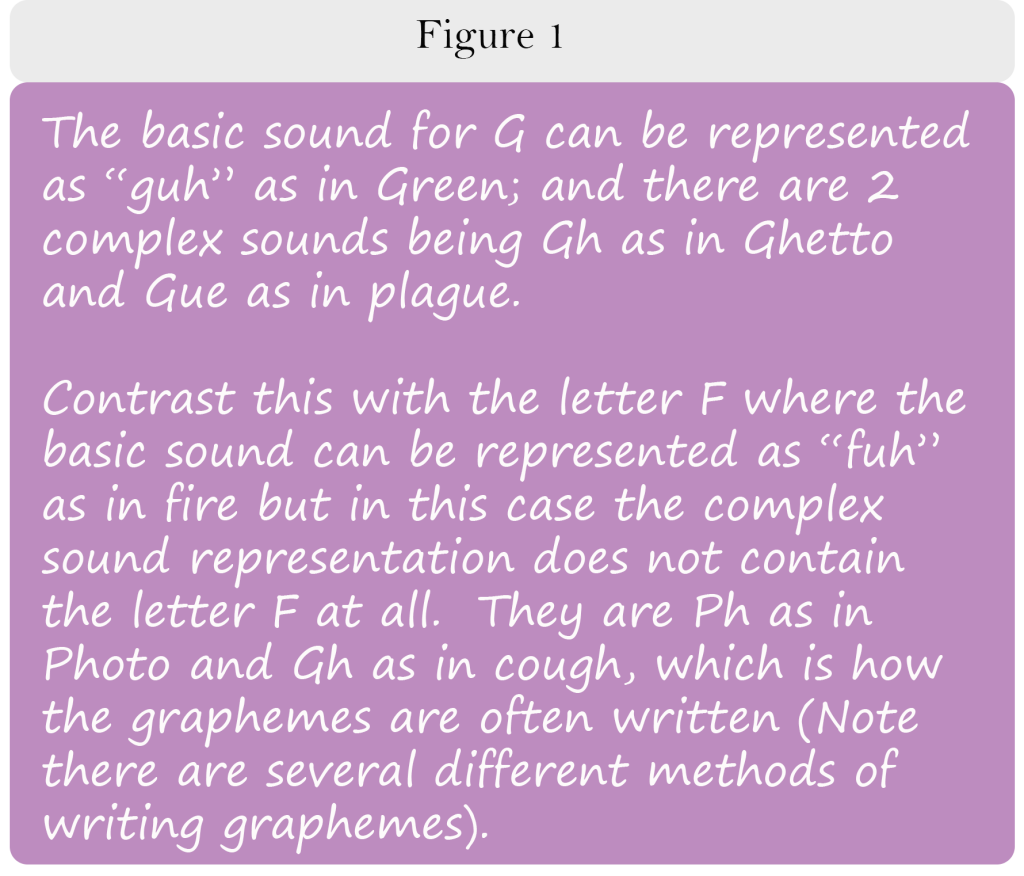
When first entering the topic of phonics, an immediate complexity discovered is that many letters of the English alphabet have more than one sound, a basic sound and a complex sound, and there are sometimes several usage types for the complex sound (see Fig.1 for example). In the Phonics teaching method it is no longer acceptable to simply call out a word associated with a thing that begins with each letter of the alphabet (e.g. A is for Apple). Rather we must be clear on whether we are using basic or complex sounds and in what context.
To take a very complicated example: X cannot be for Xylophone anymore because the correct phonic for X is “KS” as in X-Ray, which isn’t really a word as such but rather a type of a “ray”. We don’t have the option of using a complex X sound because there isn’t one. Xylophone is spelled with an X but is actually an example of a complex Z sound… Nightmare! But this illustrates the power of teaching through Phonics because children learn this early and once embedded it becomes second nature, they don’t need to think about it, they just know it. And that is the route to true fluency.
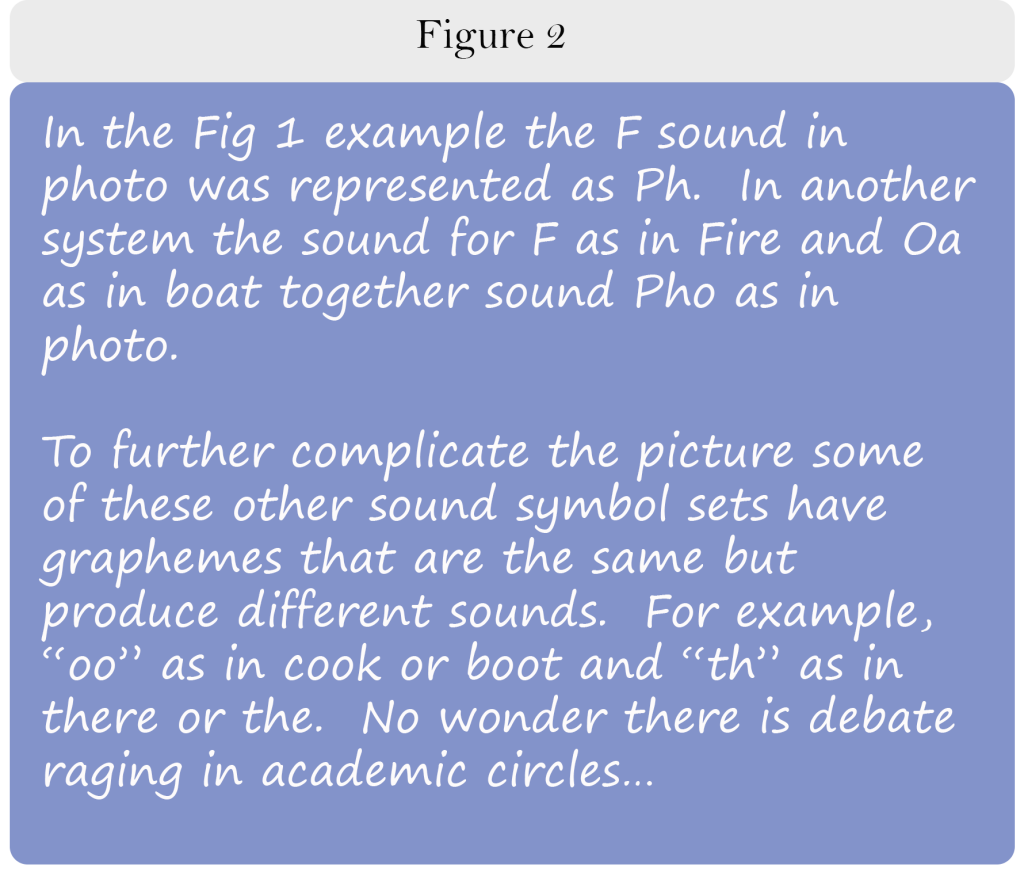
There are more than 44 Phonics sounds in all. There are also different conventions for representing sounds both phonically and graphically and this variety of graphical representation of sounds can cause some confusion and argument. The most contentious part of phonics seems to be not so much the sounds themselves but the method or system to categorise and teach them. Minefield! (see Fig.2 for example).
For many parents it can be daunting to get to grips with all these teaching methods, almost like learning a new language with all the technical terms employed. Thankfully this is where Purple Dragon’s research based approach comes in…
At Purple Dragon we already use phonics concepts in our Nursery years (ages 1-3) when teaching the basic alphabet. No longer do we simply teach children to recognize and say the name of the letter but also its basic sound. So “A is for Apple” becomes “A, Ah, Ah, A is for Apple”. This is a pre reading primer for the later formal phonics instruction to come. We also begin prewriting in Nursery with a variety of methods to teach children how to form the letters of the alphabet.
Purple Dragon Early Years will be launching “Jolly Phonics” for English language teaching for PreK, K1 and K2 classes in January 2026. We will be deploying the digital classroom version, “Jolly Classroom”, which incorporates Classic Phonics education methods for reading with story comprehension and writing elements. Consistent with our stated methodology, we are blending this non play-based specialist curriculum method into our overall play-based approach, as we have already done with our Mandarin book-based syllabus, which also starts at PreK level after play-based early immersion activities in Nursery.
Phonics is not a silver bullet for all English language learning. Rather it is how to give children the tools to explore the language faster and more fully by mastering technical elements such as pronunciation, reading and spelling. In addition, our wider English curriculum incorporates comprehension, grammar, creative writing, summarising and discussing etc. Learning through a play-based method remains faster and more durable so as part of our integration of Jolly Phonics we overlay play-based activities to achieve the best of both for our children.
We look forward to seeing the positive results of this investment in the children entrusted to our care.